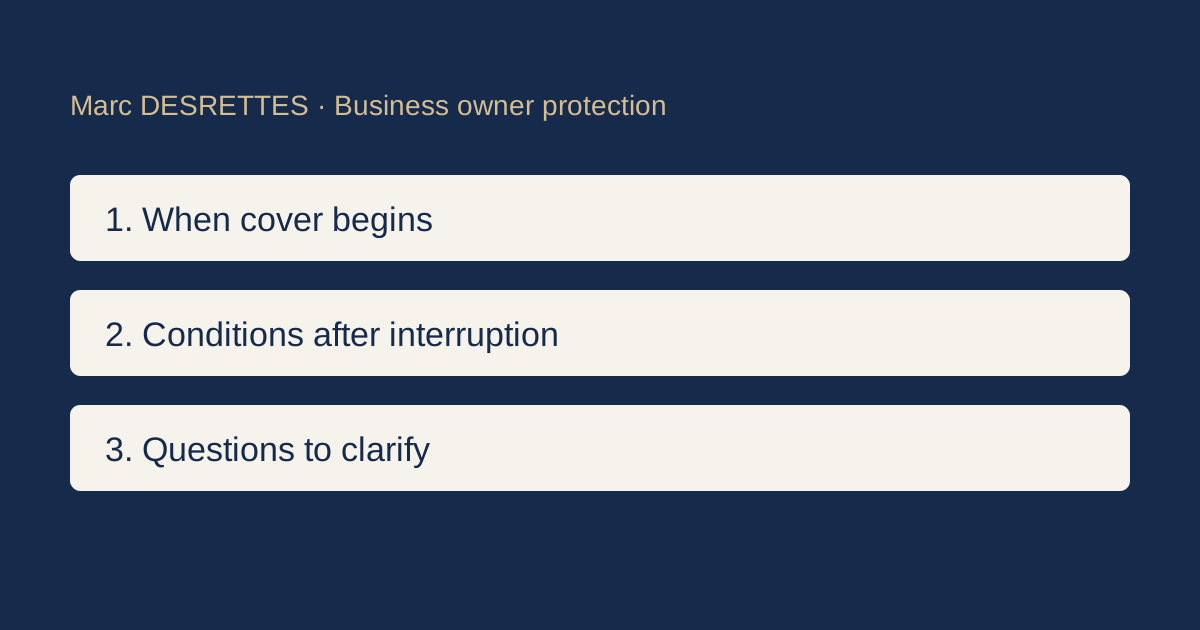
1. An amount does not describe how an interruption unfolds
Imagine the owner of a small service company who approves quotes, follows clients and organises the team. They know the amount in their benefits schedule but cannot locate the payment conditions. Their partner knows the household expenses. Their accountant knows the business commitments. Nobody has brought these three views together. This is an illustrative situation, not a real client case.
The purpose is not to uncover a mistake at any cost. It is to check that everyone is discussing the same protection. A death benefit, a benefit linked to time off work and cover for business expenses answer different questions. Before the meeting, write down what you want to protect: personal income, operating costs or the family's needs.
The central idea is straightforward: read protection as a timeline with conditions, not simply as an amount. Before comparing figures, establish what triggers a benefit, what might delay its operation and what falls outside the cover. Those questions make the discussion more precise without assuming that a claim would be accepted.
2. Distinguish the two waiting periods
CNP Assurances distinguishes the initial waiting period, called délai d’attente or délai de carence in French, from the délai de franchise after the insured event before compensation. The exact arrangements remain those in the policy.[6] Keeping the French terms beside the English explanations helps you locate them in your documents.
Draw two separate lines on a sheet of paper. Start the first at the policy's effective date and ask when the relevant cover becomes applicable. Start the second at the event itself and ask from what point the conditions could open an entitlement to a benefit. Record the answers separately rather than treating a single number of days as the whole explanation.
Ask whether the periods differ by event: illness, accident or hospitalisation. The useful question is which provision applies to the situation under discussion. Do not extend an answer given for one circumstance to every possible interruption.
This exercise is not a recommendation always to choose the shortest period. It identifies a period to discuss and connects it with resources that are genuinely available. Any decision about changing protection comes after that clarification, rather than being the starting point.
3. Read exclusions without jumping from concern to conclusion
ABE Infoservice recommends checking exclusions and identifies participation in certain sports as a point to examine. It also draws attention to contractual definitions of incapacity and disability.[5] That calls for checking the applicable wording, not assuming that every unusual activity must be excluded.
Start with the work you actually do. A job title may not explain travel, technical visits, physical tasks or daily responsibilities. Prepare a short description of your real activities and ask whether it corresponds to the information retained in the insurance file. Questions about declarations or updates need answers that relate to the particular policy.
If wording is unclear, record the clause title and page reference. Ask for an explanation of its scope, limits and the document that governs the answer. Do not rewrite an exclusion yourself and infer that you are covered. A clearly identified uncertainty is more useful than an unconfirmed interpretation that happens to sound reassuring.
Medical information does not belong in a public message or a general contact enquiry. If a question needs health details, ask the relevant organisation which appropriate channel to use. Avoid sending a complete medical file to several people simply because you are trying to obtain a quick explanation.
4. Establish what the headline amount means
ABE Infoservice distinguishes forfaitaire benefits, based on an amount specified by the policy, from indemnitaire benefits, linked to loss of income. It also highlights the importance of understanding the calculation basis.[4] Ask how that distinction relates to your documents instead of comparing two figures in isolation.
Useful questions include: which income was used as a reference, what evidence supports it, which other benefits would be taken into account, and what period does the displayed figure represent? The purpose is not to predict the answers. It is to prevent the same term from carrying different meanings for you and the person explaining the policy.
France Assureurs recommends accounting for personal and professional changes and contacting the insurer promptly after an insured event.[3] Describe changes in activities or remuneration and ask which points need reviewing. Do not turn the checklist into your own benefit calculation: clarifying the framework still requires the contractual terms and relevant circumstances.
5. The overlooked issue: expenses do not share one timetable
The first point to examine is the need to protect, before considering a policy to select. On one side, list household commitments that need to continue: housing, food, children and personal repayments. On the other, record business commitments such as premises, staff, subscriptions, finance and essential services. Keep the lists separate so that the discussion does not confuse their purposes.
Then add the resources you are considering using, along with their practical limitations. Does the money actually exist in an accessible account? Is it already earmarked for a payment? Would using it require a discussion with a co-owner or professional adviser? Business cash should not be presented as immediately available household money without examination.
The blind spot is not always an absent policy. It can be an absence of agreement about which expense the policy is intended to address. In the opening scene, the owner thinks about household income, their partner about the mortgage and the accountant about company commitments. Naming those expectations prepares a useful discussion without setting undefined needs against each other.
6. Four shortcuts to avoid during a review
First, bringing only the last page of a benefits schedule. It helps you find your bearings but does not explain a clause on its own. Gather the available policy terms and amendments too, marking missing documents. If several versions carry different dates, ask which version applies rather than selecting the one that seems most favourable.
Second, treating a general explanation as confirmation for your own file. An article, brochure or conversation can explain a concept. The answer to your question then needs to connect that concept with your cover, the event being considered and the relevant documents.
Third, wanting an immediate change because a term sounds worrying. Start by asking what it means, what its implications might be and which options could be examined. This article recommends neither cancellation nor replacement nor an increase in cover. Understanding comes before a decision.
Fourth, leaving a question open without a named next step. For every unresolved point, note who should answer, which document is needed and what response is expected. Keep a request sent, an answer received and an actual confirmed amendment as three distinct stages.
7. Prepare a conversation with answers you can check
Gather the benefits schedule, available general and personal policy terms, amendments and a current description of your activities. Add a simple overview of household needs and business commitments, without spontaneously sending sensitive documents. If you cannot locate a document, mark it as missing rather than replacing it with your recollection.
Organise the meeting around five questions: which cover are we discussing, when does it apply, which event and evidence matter, which exclusions or limits need clarification, and what need would remain to organise during the period identified? Aim to leave with answers anchored in documents and a short list of outstanding checks.
The cabinet can help connect protection with income, family needs and continuity of activity. The insurer or relevant organisation must clarify the cover's conditions; an actual event requires examination of the file. A preparatory wealth review is therefore not a decision on an insurance claim, and should not be presented as one.
If this reading raises questions, prepare a first conversation with Marc DESRETTES. A useful starting point is not a request for a different policy. It is a clear description of the need to protect, followed by a distinction between what is documented, what needs explaining and what may eventually require a choice.
Frequently asked questions
Do délai de carence and délai de franchise mean the same thing?
No. CNP's explanation places the carence at the beginning of cover and the franchise after the event. Check the exact dates and conditions in your policy.[6]
Does the same franchise apply to every interruption?
Do not assume so. Ask which provision concerns the event being discussed and where it appears in the applicable terms. An answer about one situation is not enough to explain another.
Is the amount shown necessarily what I will receive?
Check the benefit basis, conditions and limits. ABE distinguishes forfaitaire and indemnitaire arrangements. A schedule is not a decision about an actual event.[4]
Should I change my policy after reading this?
Not on the basis of this article alone. First identify the relevant clauses, your needs and unresolved questions. Any potential change needs an appropriate assessment, without assuming a different policy would suit you better.
What if I have already stopped working?
France Assureurs recommends contacting the insurer promptly after an insured event.[3] Ask about the process and documents for your circumstances without waiting for a wealth review. This article prepares a discussion; it does not process a benefit request.
Clarify the questions that remain open
To connect your protection with household needs and your professional activity, prepare a first conversation with Marc DESRETTES.
Prepare a first conversationSources and reading
Sources consulted on 21 October 2026. These general explanations do not replace your applicable policy terms.
- [3] France Assureurs — 15 réflexes pour bien s’assurer en prévoyance (21 septembre 2020)
- [4] ABE Infoservice — Que faut-il savoir sur l’indemnisation ?
- [5] ABE Infoservice — À quoi faut-il faire attention avant de souscrire un contrat de prévoyance ?
- [6] CNP Assurances — Délai d’attente et délai de franchise (2 septembre 2026)