1. Start with your working history, not the figure on screen
Imagine the owner of a small services business opening her pension record. She recognises her earliest employers, but the following sequence of activities is harder to understand. One year looks incomplete and she is unsure which organisation to contact. She opened the service to explore a retirement date. Her first useful task turns out to be reconstructing what she actually did. This is an illustrative situation, not a real client case.
The official Ma carrière service displays a chronological career history, recorded quarters and points, and periods that may require checking. Info Retraite also provides access to a downloadable record and contact details for pension schemes.[1] The record is therefore a practical starting document, not simply paperwork to file away.
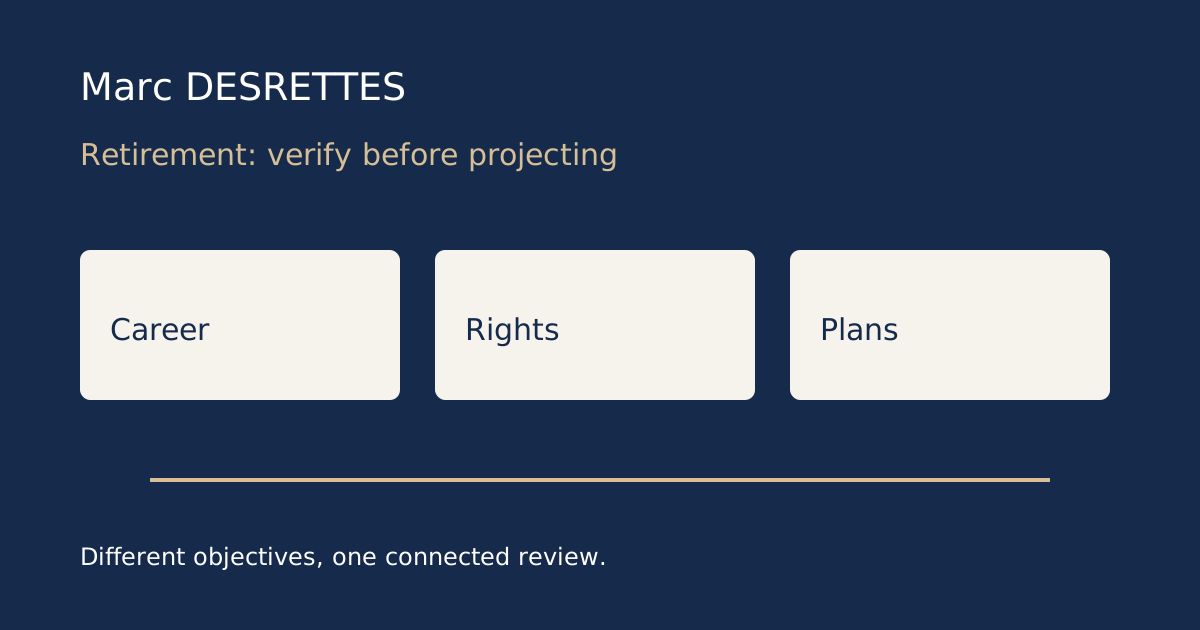
The method proposed here separates three things: your account of your career, the information held by the schemes and the future you are considering. Mixing them can lead to discussing a projection while an underlying fact remains unclear. Keeping them distinct makes the next conversation more precise without pretending that every uncertainty can be resolved immediately.
2. Reconstruct the transitions worth asking about
Prepare a personal timeline with employers or activities, approximate dates and the changes you remember. Mark a move from employment to self-employment, concurrent activities, a break from work or time abroad. The purpose is not to assume that each transition has created missing rights. It is to identify what you need to understand before relying on a projection.
Info Retraite encourages users to follow successive jobs and other life periods known to the schemes, and to request corrections where necessary. It also recommends keeping payslips and employment evidence.[2] For your preparation, bring together the documents already available before starting a search for difficult archives. Make a note of what is missing rather than delaying the whole review.
An entry you do not remember is not automatically wrong; a familiar employer name does not prove that every detail has been settled. Write down the question without deciding the answer. For example, ‘Does this period correspond to my self-employed activity?’ is more useful than ‘I definitely have missing rights.’ The relevant scheme needs to clarify the issue.
3. Separate a suspected issue from a confirmed correction
Use a simple list with three columns: period to clarify, evidence available and response needed. Add a follow-up date for each request. This modest organisation helps avoid repeating searches, losing a response or considering an issue closed merely because a form has been submitted. It also helps keep a meeting focused on what is still unresolved.
The correction route depends on your situation and the service available to you. Info Retraite describes scheme contacts and an online correction service whose availability depends on age.[1] Check the route through your official account. This article does not establish your individual procedure, any processing deadline or the treatment of a particular period.
An often underestimated distinction is the gap between submitting a question and having the underlying information updated. Keep the request, the reply and the version of the record checked afterwards. If a period is still being discussed, leave it visible in your preparation. A suspected discrepancy is not, by itself, evidence that a pension increase will follow.
4. Read a simulation as a scenario, not a promise
Assurance retraite explains that its estimate uses information from the career record and displays estimated amounts for different retirement ages. The service also allows users to personalise some information and project future changes.[3] Read the result together with the inputs and assumptions rather than extracting a single number from the screen.
Name each scenario you want to discuss: continuing the activity you currently envisage, exploring a professional change or reducing your working pace. State what has been decided and what remains only possible. An intention to slow down is not the same as an operational change already under way. This prevents comparisons between figures based on different working-life stories.
Also check how the amount is presented: gross or net before income tax, the proposed retirement date and the career assumptions. These distinctions appear in the official service description.[3] Do not turn that figure straight into a household spending budget. Preparing a budget and reading a pension estimate answer different questions, even when both belong in the same planning conversation.
5. Connect retirement information with the life you want to organise
Once the uncertainties in the record are identified, the wealth-planning conversation can address your intended way of life. Do you want to stop working, hand over responsibilities gradually or keep a different activity? Does your partner have the same timetable? Will a loan, family support or housing project still need funding? These questions do not determine pension rights, but they help define the needs to examine.
The preparation framework proposed for a conversation with Marc connects the business, household income and personal projects before discussing a savings arrangement. A career record can help explain part of your future resources. It does not, on its own, describe household spending, other commitments or the decisions the family wants to make together.
In the illustrative owner's situation, three tasks can advance without being confused: asking the scheme about an unclear period, explaining her preferred working pace and describing the household expenses she wants to meet. None of these tasks replaces the others. Keeping them separate avoids waiting for a supposedly perfect figure before beginning to organise useful questions.
6. Avoid shortcuts that make a meeting less useful
The first shortcut is to wait until retirement feels close before opening your record. Info Retraite presents career monitoring as something available throughout working life.[2] Starting with a calm review and a list of questions does not commit you to a retirement application or an immediate savings decision. It simply gives the discussion a clearer foundation.
The second shortcut is to ask a wealth adviser to confirm rights that must be examined by pension organisations. Useful coordination means identifying questions for those organisations, then integrating their replies into the broader planning discussion. The firm should not be presented as replacing the schemes' examination of an individual career record or retirement entitlement.
The third shortcut is to change your savings commitment solely on the basis of an estimate you have not fully understood. Before any decision, separate verified information, answers still awaited and assumptions about your future life. The aim of this preparation is not artificial certainty. It is to make uncertainty clear enough to discuss without treating an open question as a settled fact.
7. Bring a short file and precise questions
For a first conversation, prepare a dated version of your record, your professional timeline, the issues to clarify and, if available, an estimate accompanied by its assumptions. Add a short description of your project: intended working pace, household circumstances and significant commitments. Never send your password or official-account login codes as part of this preparation.
Three questions can frame the discussion: ‘What still needs confirmation from my pension scheme?’, ‘Which assumptions explain the projection I have brought?’ and ‘Which family needs should we examine separately from that projection?’ A useful outcome is an action list with an appropriate contact for each question, not a solution chosen before the situation is understood.
Frequently asked questions
Should I wait until late in my career to read my record?
No. Info Retraite makes career information available at any age. An initial review can identify questions and evidence to recover without committing you to a retirement application.[1][2]
Does an apparently missing period mean a correction will increase my pension?
That cannot be concluded here. The relevant scheme needs to examine the period, its evidence and its treatment. This article calculates neither individual rights nor the effect of a correction.
Does an online estimate replace checking my career?
No. Assurance retraite states that the simulation uses information in the career record. Read the result together with the information and assumptions used.[3]
What can a wealth-planning conversation add?
It can help connect retirement questions with your activity, commitments and family projects. The relevant pension organisations remain responsible for examining rights and processing career-record corrections.
Clarify before choosing
Would you like to organise your retirement thinking before moving towards a solution? Prepare a first conversation with Marc DESRETTES around your career, the points still to confirm and your personal projects.
Prepare a first conversationSources consulted
- Info Retraite — Ma carrière
- Info Retraite — Suivre mes droits dès mon premier emploi
- Assurance retraite — Estimer le montant de ma retraite
Official Info Retraite and Assurance retraite sources accessed October 20, 2026. This article does not calculate individual pension rights or retirement dates.