
Start with a date, not a target return
Imagine an entrepreneur running a small services company. Trading is healthy. She has started investing, is repaying her home loan and plans to help fund her child’s education. At the same time, the company is preparing to hire. On paper, her wealth feels reassuring. Yet when asked which personal funds she could use without disturbing long-term investments, the answer becomes less clear.
This is a fictional scene, but the question is worth asking: what money will be needed, by whom and when? The approach described here starts with the purpose of money rather than a comparison of investment products. A reserve for unexpected events, a planned property deposit and retirement capital do not serve the same purpose. They should not be treated as interchangeable simply because they appear on one financial summary.
The French financial regulator, the AMF, distinguishes precautionary savings from capital being built for a project. The objective helps clarify the need for access, the time horizon and acceptable risk.[2] This framework does not provide a personal allocation. It gives the conversation a useful starting point before an investment decision.
1. Separate household security from business requirements
To prepare a personal review, start with two distinct lists: what the household needs to fund and what the business needs to preserve. Do not immediately add every account balance together. Ask instead who owns each sum, what role it plays and what checks would be necessary before using it. Any movement between business and personal finances should be assessed with the relevant professionals, including the accountant.
Within the household budget, distinguish essential spending from spending that can be adjusted. Housing, repayments, everyday costs and family commitments cannot necessarily be postponed as easily as a discretionary purchase. Include annual deadlines: a reassuring monthly budget can hide a foreseeable expense that has not been planned for. The aim is not to cut everything. It is to identify what must continue to be paid.
Then consider where income comes from: regular remuneration, contemplated distributions, a partner’s earnings or other resources. Money already received and money expected should not be treated as one certainty. A useful working question is: if an expected payment does not arrive on time, which family commitment becomes difficult to meet? This is a planning question, not a prediction of trouble.
2. Give each part of your savings a purpose
The first function is a reserve for unexpected events. Its purpose is not to fund spending whose date is already known. It preserves room to manoeuvre when circumstances differ from the plan. An appropriate amount needs discussion in light of household circumstances, income stability and existing protection, without turning a general rule of thumb into a universal prescription.
The second function covers identified projects: home improvements, education, moving home or a professional transition. For each project, write down a timetable, a working budget and the uncertainty around it. A plan can be definite in principle while its eventual cost remains unclear. That uncertainty should be made explicit rather than hidden behind an estimate that looks more precise than the available information justifies.
The third function is long-term capital. Before defining it, ask which sums are assigned neither to the reserve nor to approaching projects. This classification prepares a review; it is not a product recommendation. It helps prevent the same money being counted for a child’s education, retirement and a future property deposit at the same time. Different purposes may require different decisions.
3. Access, investment horizon and safety are different questions
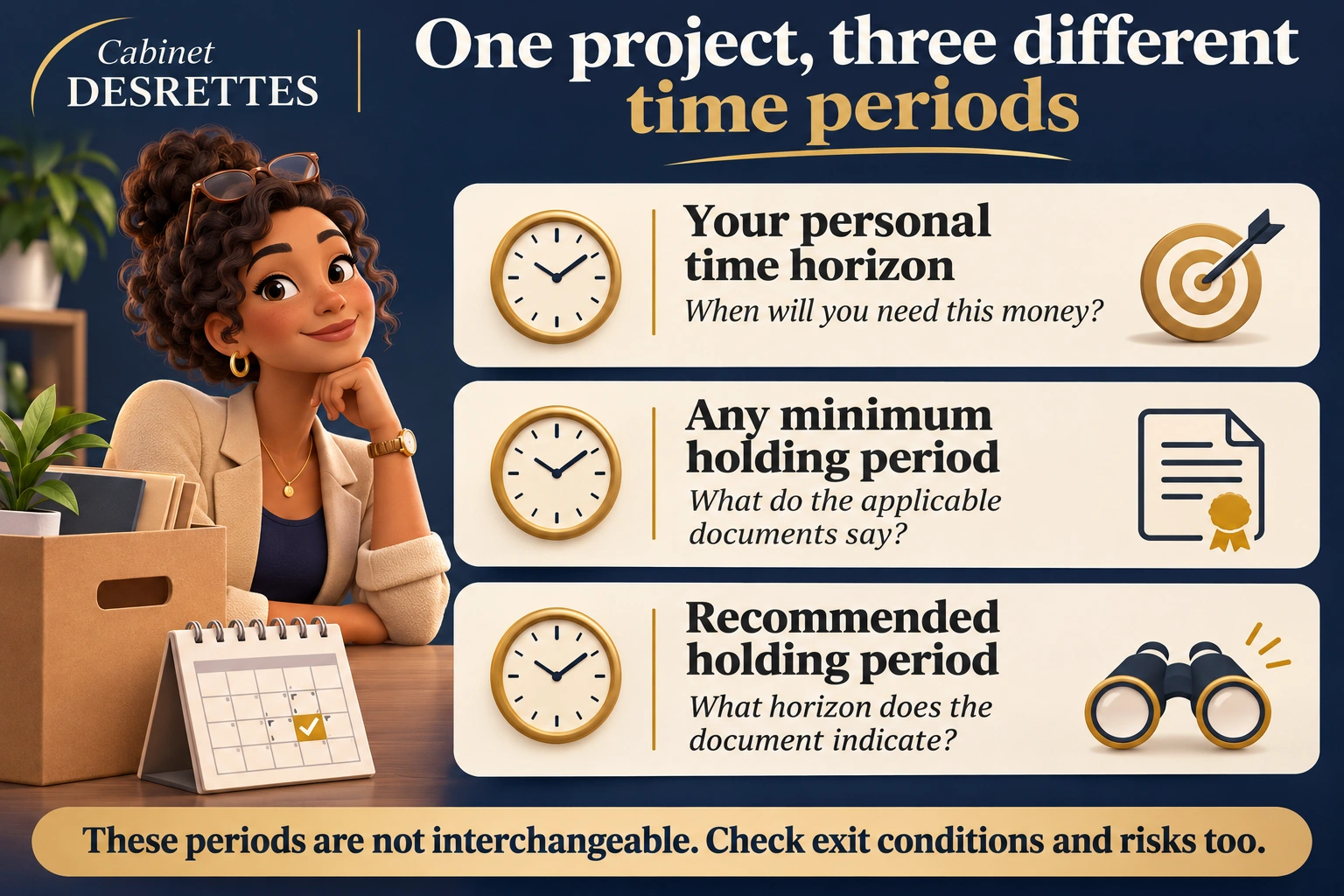
An investment horizon is the period during which you expect to hold a financial product. The AMF encourages investors to check that this horizon fits the investment’s characteristics.[1] For a business owner, the practical question is: could I genuinely leave this money invested if the business paid me less or if my family timetable changed? An aspiration to invest for the long term needs to be tested against actual commitments.
Being able to request a withdrawal does not describe the whole position. In its educational tool Mon zoom épargne, the AMF distinguishes risk, horizon and availability.[3] Three separate questions therefore matter: is an exit possible, how long might it take, and how uncertain is the amount recovered? Answers should be checked in the documents applicable to the particular investment, rather than inferred from its name.
Before deciding, ask for a written explanation of timing, any charges, withdrawal conditions and risks. Where a key information document applies, reading it is a useful part of these checks.[1] Do not conclude that an investment meets a short-term need merely because withdrawal is technically possible. Tax and contractual constraints also need examination for the circumstances concerned. This article does not determine their treatment for an individual reader.

4. The overlooked issue: several needs arriving together
Return to our entrepreneur. Recruitment requires the company’s attention, her child’s education is approaching and home repairs become necessary. None of these events is exceptional on its own. Pressure emerges when they coincide and the same savings were implicitly expected to cover all of them. A broad total can feel reassuring while the calendar tells a more complicated story.
A straightforward exercise is to create a shared timetable without mixing the accounts: business commitments on one side and family needs on the other. Add a column for the expected resource and another for the fallback to investigate. The purpose is not to forecast every difficulty. It is to make dependencies visible enough to discuss them calmly before a decision is urgent.
Then test a delayed income payment, a higher family expense and an earlier project date. These are working assumptions, not forecasts. If every scenario requires a hurried sale or an unexamined transfer from the company, the immediate question may not be which new investment to choose. It may be how accessible resources are organised and which uncertainties need professional review.
5. Mistakes that make the decision harder
The first mistake is starting with a desired return before defining when the money will be needed. The second is looking at total wealth without distinguishing what can actually be mobilised. The third is calling money an emergency reserve when it is already committed to building work. Another product does not resolve these confusions by itself. The functions of the money first need to be clarified.
Another mistake would be expecting insurance to replace every accessible reserve, or expecting savings to replace every form of protection. Guarantees, conditions and time limits need their own review before being connected to the household budget. Our related article on income interruption and the business-owner protection guide explore that connection. Neither an account balance nor the existence of a policy is a complete answer on its own.
Finally, avoid making a decision alone when it also depends on a partner, an associate or the business calendar. A first conversation should identify the professionals whose input is useful, not simply add more participants. An unresolved legal, accounting or contractual issue should remain an open question until it has been checked. Identifying the limit of the available information is part of sound preparation.
6. Prepare a useful conversation with Marc DESRETTES
Prepare a concise overview of household resources, essential spending, loans, projects and major deadlines. Add investment statements and the documents describing their conditions. A structured list is enough to begin: do not send sensitive information through a channel that has not been agreed with the firm. The purpose of preparation is to make the discussion clearer, not to assemble every document before you can speak.
The proposed starting point connects the business, income, family, protection and wealth. What currently funds your security? Which sums already have a purpose? Which project comes first? What needs checking before capital can be considered accessible? These questions prepare an assessment. They do not predetermine which solutions might later be considered or whether a change will be appropriate.
A useful outcome is a clearer map: identified resources, uncertainties to resolve, documents to review and professionals to consult. The right result is not necessarily a new subscription. It is first the ability to distinguish money that needs to remain accessible from money that can be committed to another horizon. That distinction provides a more reliable starting point for the next conversation.
Frequently asked questions
How much emergency savings should a business owner keep?
This article does not prescribe a universal amount. The need should be discussed using essential spending, income regularity, approaching projects and existing protection. A general benchmark does not replace a household review.
Is an accessible investment necessarily risk-free?
No. Availability describes the ability to recover money, while risk includes uncertainty about its value. The AMF treats these characteristics separately in Mon zoom épargne.[3]
Can a contemplated dividend fund a near-term project?
When preparing a budget, distinguish money received from payments that remain uncertain. Distribution conditions and their consequences need checking with the accountant before a decision is made.
Should every investment be changed before a first meeting?
No. Start by listing your holdings and their objectives. The conversation identifies useful questions and checks without assuming that any change is necessary.
Does the recommended holding period tell me when I can recover my savings?
No, it does not answer the exit question by itself. Distinguish your personal horizon, any minimum period and the recommended period, then ask for clarification of the applicable conditions, timing, charges and risks. This article sets no universal delay and makes no recommendation to sell.
Clarify before choosing
To clarify what should remain accessible and what can be built over time, prepare a first conversation with Marc DESRETTES.
Prepare a first conversationSources consulted
- AMF — Avant de souscrire : bien connaître son horizon de placement
- AMF — Définir son objectif d’épargne pour bien choisir son placement
- AMF — En savoir plus sur le fonctionnement de Mon zoom épargne
AMF sources published October 19, 2018 and October 17, 2023, reread November 17, 2026. Only the cited educational principles are used; numerical and tax examples are not applied to your circumstances. The terms of each holding still require checking in the applicable documents.