Short answer.
To prepare for maternity as a business owner in France, examine social benefits, household income needs and business cash separately. Your status, contribution-based earnings and actual interruption of work matter. Available reserves, organised cover and a return-to-work budget complement that review, without assuming that public benefits or private insurance will meet every need.
The real objective: stop working without funding two shortfalls
Fictional example: Claire runs a small agency. Her order book is full and several invoices remain unpaid. She expects those receipts to finance her absence. When she sets out the timetable, she sees that they will first pay subcontractors for work already delivered and meet ongoing expenses. Meanwhile, her household still relies on her usual income. The same money had effectively been allocated to two needs.
The central point is simple: checking benefits is not the same as preparing an absence. You need to know what will actually be available, when, and to whom. At Marc DESRETTES, the starting point is the need to protect: can the household manage without drawing on business cash already committed elsewhere? Can the business continue without requiring personal interventions that conflict with the applicable interruption of work?
What is most easily underestimated is not a dramatic expense. It is the gap between a definite payment and a resource whose arrival remains uncertain. It identifies commitments, confirmed resources and assumptions that need a margin. This helps you choose what to clarify first rather than treating every uncertainty as a reason to buy insurance.

Start with social protection status, not just the business name
“Business owner” describes a responsibility, not one French social protection category. A sole trader, a micro-entrepreneur, an independent professional and the president of a SAS should not be given the same calculation. Legal form, pay for a corporate office and previous insurance affiliations are separate questions.
Service Public’s guidance for sole traders and its SASU guidance illustrate this distinction: self-employed maternity benefits and the affiliation of a paid company president follow different explanations. Our guide to self-employed and micro-entrepreneur maternity rights examines benefits and the role of earnings. The article on SAS and SASU presidents with variable pay explains why holding a corporate office is not the same as having an employment contract.
Healthcare reimbursement must also be separated from cash benefits replacing income. Having medical expenses covered does not establish the amount of daily benefits, known in France as indemnités journalières or IJ. Equally, having no current remuneration does not establish the absence of every right: the competent fund needs to examine previous work and other circumstances.
A contracted healthcare practitioner or auxiliary, commonly referred to as a PAMC in France, needs confirmation of the relevant scheme and supporting documents. A calculation designed for another self-employed person is not an individual answer for that situation.
Build two budgets that do not borrow the same money
The household budget starts with essential spending: housing, food, loans, insurance, transport and family arrangements. Add anticipated new expenses without treating every possibility as a commitment. Set against them the partner’s genuinely available income, confirmed benefits and accessible savings.
The business budget follows a different logic: premises, software, employees, subcontracting, debt and social contribution or tax payments identified with the accountant. Reconcile the bank balance with payments already scheduled. Business overheads do not automatically disappear into the personal allowance or daily maternity benefits you expect to receive.
- For each resource, identify who receives it and its likely payment date.
- For each expense, separate committed costs, adjustable costs and due dates.
- For each reserve, record the need it funds so it is not counted twice.
Our article on fixed costs and replacement arrangements during maternity leave develops this approach. It does not start by requiring a new insurance policy. It first establishes whether the need concerns spending, the timing of receipts, operational arrangements or protection worth reviewing. Distinguishing these needs avoids asking a single payment to solve several different problems.
The summary to keep
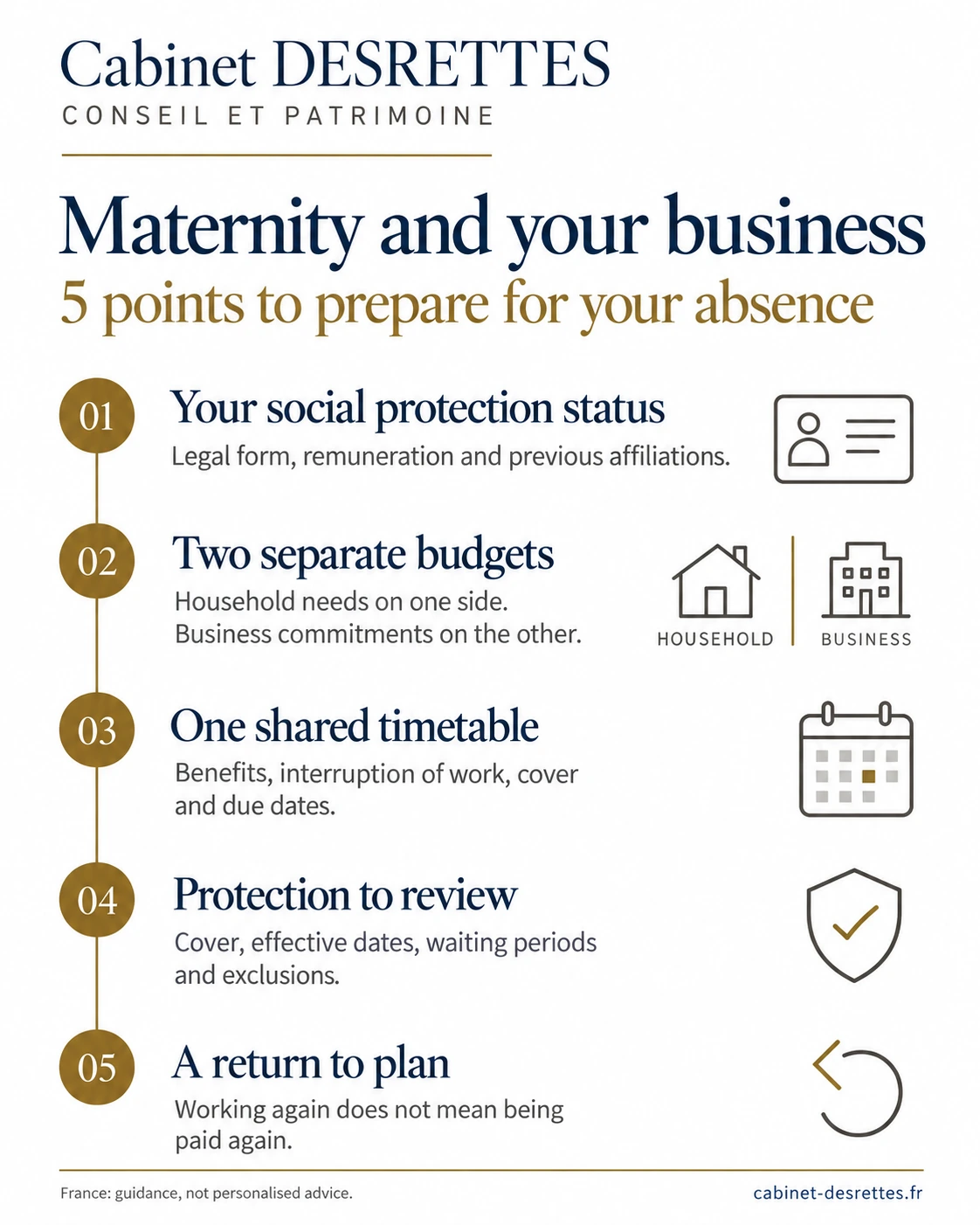
Five points to prepare for your absence
Status, budgets, timing, protection and the return: five connected questions to examine before making decisions.
Put benefit conditions and operational cover on the same timetable
Maternity benefits come with conditions and an interruption of work that must be respected. Official sole-trader guidance mentions a minimum affiliation period and a compulsory period of cessation; that is not a complete eligibility test you can apply in isolation. The relevant duration also depends on the situation. Another entrepreneur’s timetable should not become yours by default.
Before the absence, list tasks that previously depended entirely on you: access to files, client contact, banking deadlines, deliveries or urgent decisions. Identify the proposed cover, its limits and the practical means required. This preparation belongs before leave. Arranging a replacement does not mean that you may continue working during an indemnified period.
A signature, a delayed customer payment and an urgent request can raise different questions. This article does not classify any particular act as permitted during cessation. Describe practical situations to the health insurance fund and, where company powers are involved, to a legal adviser. Saying “I will only keep managing things” does not resolve those issues.
If you are also considering France’s additional birth leave, add it as a separate period to examine. That scheme has its own conditions and procedures. Extending a line labelled “maternity” in a spreadsheet is not enough to establish the benefit or the work arrangements.
Review protection without expecting it to finance the whole leave
Maternity leave, an absence connected with a medical condition and incapacity covered by private insurance are not three names for the same event. The article on pregnancy complications and income protection helps prepare that review. Income or business-expense cover must be read in light of the insured event, definitions, effective date and limitations.
The useful question is not “Do I have protection insurance?” but “What payment does this document provide for which situation?” Gather the applicable policy wording, individual terms, selected options and amendments. Identify waiting periods, deferred payment periods, exclusions and evidence requirements. The product name cannot answer those questions.
Any birth-related payment, income replacement for incapacity and reimbursement of business expenses must also be distinguished. They are not interchangeable. A general brochure establishes neither that an option was selected nor that an individual claim will be accepted. Do not put a private payment into the budget as certain until its conditions have been established.
The cabinet’s income and family protection review starts with those needs. A review can help explain existing arrangements without systematically replacing policies or promising a solution for a pregnancy that has already begun. Where a claim is already under way, the insurer’s reporting procedures remain a separate priority.

Plan the return: working again is not the same as being paid again
A return needs a date for availability, but also a commercial timetable. You may need to rebuild appointments, contact clients, deliver services and then wait for payment. Create a scenario in which receipts recover more slowly than expected.
Avoid making the budget depend on an immediate full-capacity return. Discuss household arrangements, childcare constraints and professional commitments already made. Do not promise clients a volume of work inconsistent with the scenario you have chosen. If medical circumstances change, healthcare professionals and the relevant organisations must address their respective questions.
A pause or lasting reduction in activity also warrants a career-record review. Our guide to children, career breaks and self-employed retirement rights distinguishes entitlements to check from future income to prepare. Keeping retirement in view does not mean tying up money needed today. Accessible reserves and coherent family protection may remain the immediate priorities.
Finally, set a date after your return to compare assumptions with reality: receipts, costs, income taken out and the remaining margin. A review prevents outdated assumptions from continuing simply through habit, and makes it easier to see whether the return budget still reflects the actual business.
Avoid shortcuts and prepare a useful first conversation
Three mistakes weaken preparation: treating turnover as personal income, treating the business bank balance as a free household reserve, and treating a benefit estimate as a certain payment. A fourth is arranging the absence around your constant availability. The plan should instead make it possible to respect the applicable interruption of work.
For a first conversation, bring an outline rather than trying to assemble a perfect file:
- Your current status, dates of activity changes and the relevant organisations.
- Professional earnings and household resources, separated from business receipts.
- Personal and business commitments throughout the absence and return period.
- Benefit estimates or replies from the fund, with their assumptions and dates.
- A list of policies and the applicable documents you already have.
Then allocate the questions. The fund examines statutory benefits; the accountant reconciles earnings, declarations and cash flow; a legal adviser deals with company powers or replacement arrangements where necessary. The cabinet can put income needs and protection into perspective. It does not decide entitlements on behalf of the paying body.
A successful conversation should leave you with a clear priority: which resource needs confirmation, which expense needs a reserve, and which cover arrangement needs organising? It does not require an immediate purchase decision or medical information in an appointment form. The practical outcome is a clearer financial picture, not a promise that every uncertainty can be removed.
Explore your situation in more detail
The six related maternity guides, according to your status and the questions you need to prepare.
Frequently asked questions
Do maternity benefits also pay business overheads?
Treat the needs separately. The personal benefits described by statutory schemes do not establish funding for business rent, employee pay or debts. Build a household budget and a business continuity budget, then check which resources are allocated to each.
Does having no current remuneration mean I have no rights?
No. That information alone is not enough. Healthcare, cash benefits and rights potentially arising from other work or previous circumstances must be distinguished. The competent fund needs to examine your history and the applicable conditions.
Does arranging a replacement let me continue managing during leave?
A replacement prepares business continuity, not a general permission to work during an indemnified period. Describe the proposed acts to the fund and the necessary powers to a legal adviser, without assuming that an occasional intervention is permitted.
Does private protection insurance automatically fund maternity leave?
No. Maternity, medical conditions and contractual incapacity must be distinguished. Guarantees, options, effective dates, deferred payment periods and exclusions must be read in the applicable documents. A brochure or product name does not establish an individual benefit.
When should the return to work enter the budget?
From the start of planning. The end of leave does not guarantee immediate receipts. Allowing for commercial restart, payment terms and a slower return helps size the reserve without confusing future receipts with available cash.
Prepare a conversation about my income and protection
Illustrative photographs: Pexels 7055875 · Pexels 7485261 · Pexels 7155198. The people shown are not presented as clients of the cabinet.
Sources
Sources consulted on 28 October 2026.